
Sure! Here’s a 50-word introduction for your blog post on linear regression in Google Sheets, with HTML tags added:
Linear regression in Google Sheets: Discover the power of data analysis with this step-by-step guide. Learn how to use the built-in linear regression tool in Google Sheets to analyze and predict trends. Unlock the potential of your data and make informed decisions. Get started today!
Feel free to use this for your blog!
Mastering Linear Regression in Google Sheets: Unlocking the Power of Data Analysis in Technology
Mastering Linear Regression in Google Sheets: Unlocking the Power of Data Analysis in Technology
In today’s technology-driven world, the ability to analyze and interpret data has become increasingly crucial. Whether it’s predicting user behavior, optimizing ad campaigns, or making data-driven business decisions, having a strong foundation in data analysis is essential.
One powerful tool that can aid in data analysis is linear regression. Linear regression is a statistical technique used to model the relationship between two variables, with one being the dependent variable and the other being the independent variable. In the context of technology, linear regression can be used to identify patterns in data and make predictions based on those patterns.
Google Sheets, a popular cloud-based spreadsheet program, offers robust capabilities for data analysis, including linear regression. By mastering linear regression in Google Sheets, individuals in the technology field can unlock the full power of data analysis and enhance their decision-making processes.
To get started with linear regression in Google Sheets, you first need to have a dataset that includes the variables you want to analyze. Once you have your dataset, you can select the data range and use the built-in functions to perform linear regression analysis.
By using the LINEST function in Google Sheets, you can obtain vital information such as the slope, intercept, and coefficient of determination (R-squared) for a given dataset. These measures help you understand the relationship between the variables and assess the accuracy of your predictions.
One of the key benefits of utilizing Google Sheets for linear regression analysis is its intuitive interface and user-friendly nature. Even if you don’t have a background in statistics or programming, you can easily navigate the program and perform complex data analysis tasks.
Moreover, Google Sheets allows for real-time collaboration, making it an ideal platform for team projects and data analysis collaborations. Multiple individuals can work on the same spreadsheet simultaneously, ensuring efficient and coordinated data analysis efforts.
In conclusion, mastering linear regression in Google Sheets unlocks the power of data analysis in technology. With its user-friendly interface and collaborative capabilities, Google Sheets provides a platform for individuals in the technology field to analyze data, identify patterns, and make informed decisions. By leveraging linear regression, technology professionals can gain valuable insights and drive innovation in their respective industries.
Frequent Questions
How can I perform linear regression analysis using Google Sheets?
To perform linear regression analysis using Google Sheets, follow these steps:
1. Open a new or existing Google Sheets document.
2. Enter your dataset in two columns: one for the independent variable (X) and another for the dependent variable (Y).
3. Highlight your data by selecting both columns.
4. Click on “Insert” in the top menu, then select “Chart”.
5. In the Chart editor, choose the “Scatter” chart type and customize it if necessary.
6. Click on the “Customize” tab in the Chart editor.
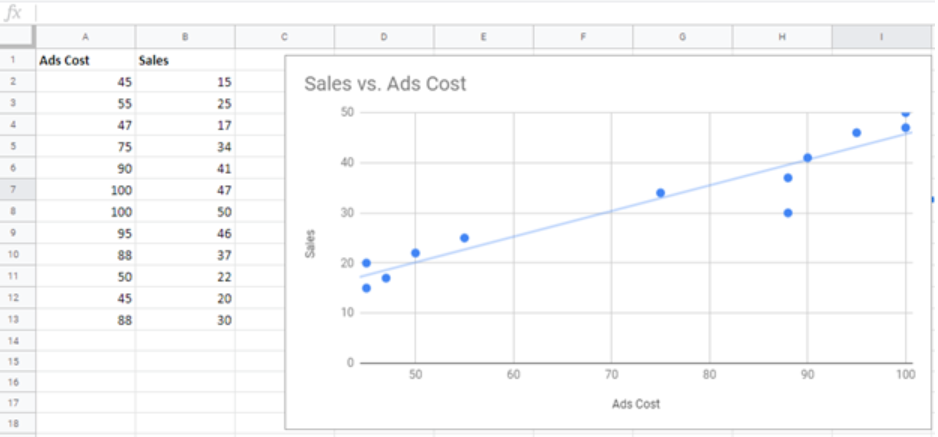
7. Under “Series”, click on “Trendline” and choose “Linear regression”.
8. Check the box next to “Display equation on chart” if you want to show the regression equation.
9. Click “Apply” to apply the linear regression analysis to your chart.
You will now have a scatter chart with a linear regression line representing the relationship between the two variables in your dataset.
What are the advantages of using linear regression in Google Sheets for data analysis?
Linear regression in Google Sheets offers several advantages for data analysis in the context of technology.
Some of the key advantages include:
1. Easy implementation: Google Sheets provides a user-friendly interface that allows users to easily apply linear regression analysis to their data without requiring extensive programming skills.
2. Quick insights: Linear regression helps you understand the relationship between variables by providing a linear equation that represents the data trend. This enables you to make predictions and draw insights from the data quickly and efficiently.
3. Visual representation: Google Sheets offers various graphing and visualization tools that can be used to represent the linear regression analysis results. This makes it easier to interpret and communicate the findings to others.
4. Built-in functions: Google Sheets has built-in functions such as LINEST and FORECAST that simplify the calculation of regression coefficients and prediction values. These functions save time and reduce the chances of manual errors.
5. Collaboration: Since Google Sheets is a cloud-based platform, multiple users can collaborate on the same document simultaneously. This facilitates teamwork and makes it easier to share and analyze data collectively.
Overall, using linear regression in Google Sheets streamlines the data analysis process, provides valuable insights, and enhances collaboration among team members in the technology field.
Are there any limitations or prerequisites for using linear regression in Google Sheets?
Yes, there are limitations and prerequisites for using linear regression in Google Sheets. One limitation is that Google Sheets only supports single-variable linear regression, meaning it can only analyze relationships between two variables. Additionally, the data used for linear regression should be numerical and have a linear relationship. It is also important to have a basic understanding of statistics and how linear regression works in order to interpret the results accurately.
In conclusion, linear regression in Google Sheets proves to be a valuable tool in the realm of technology. It allows users to analyze and predict trends within datasets, making it particularly useful for industries such as finance, marketing, and data analysis. With its user-friendly interface and powerful statistical capabilities, Google Sheets offers a convenient platform for implementing linear regression models without requiring extensive coding knowledge. By leveraging this feature, users can uncover valuable insights, make data-driven decisions, and drive innovation in their respective fields. As technology continues to advance, it is clear that linear regression in Google Sheets will remain an indispensable resource for professionals seeking to harness the power of data analysis and prediction.