
Anthropic didn’t launch a new model. It launched one model under two names, with two very different ideas of what an AI should be allowed to do. Claude Fable 5.2 is the version for everyone, with the brakes on for cybersecurity and biology. Claude Mythos 5.2 is the same model with the brakes off, reserved for organizations that pass a verification process. Behind it is a bet: that the company’s most capable model can be sold to the general public and, at the same time, put in the hands of the people working where it could do the most damage.
The announcement, published November 9, comes with impressive numbers — and caveats worth reading before taking them at face value. It’s faster, cheaper per token, and it tops the Artificial Analysis index. It’s also, by Anthropic’s own account, a model you shouldn’t use for everything, and one that keeps your data for 30 days by default.

One model, two names: what Fable is and what Mythos is
The first thing to understand is the play. Fable 5.2 and Mythos 5.2 share the same model, the same million-token context, the same output limit of up to 128,000 tokens, and the same price. The difference isn’t in the training or the size — it’s in the front door.
Fable ships with classifiers that block most high-risk cybersecurity work — penetration testing, exploit generation, vulnerability analysis in binaries — and nearly all research biology. That makes it safe to offer to everyone. Mythos loosens those restrictions and is only available to organizations that clear the Cyber Verification Program or the Life Sciences Verification Program.
There’s a detail that changes how you read the product: when Fable blocks a request, it doesn’t always say no. In cybersecurity, the query can be routed to Opus 4.8; in biology, to Opus 5. Just because the interface says Fable 5.2 doesn’t mean Fable 5.2 is the one answering. It’s a sensible call — a reply from an older model beats a wall — but it’s worth knowing.
What’s new versus 5.1 is that the guardrails block less without getting weaker, according to Anthropic: in early testing, blocks fell by about 55% — 60% fewer in cybersecurity, 40% fewer in biology. Those are internal numbers, not independently replicated, but they point at a real problem with 5.1: the model said no too often, even to legitimate requests.
Faster and cheaper: the price drops 20%
The number developers will notice most is the price. Fable 5.2 and Mythos 5.2 cost $8 per million input tokens and $40 per million output tokens, down from $10 and $50 in the previous generation. That’s a 20% cut to the standard rate, and the model also generates output up to 30% faster than Fable 5.1.
There’s an optional fast mode that multiplies generation speed by up to 2.5 times — but it costs double: $16 and $80 per million input and output tokens.
Context matters: last week we covered how the memory shortage is pushing hardware prices up, with the Switch 2 climbing from $449.99 to $499.99 and Apple warning of unprecedented costs. Anthropic’s most powerful model getting cheaper in that climate is a signal: the AI war is also fought on the per-token invoice. The fine print is that the price per token isn’t the cost per task: at full power, Fable 5.2 generates far more reasoning tokens than its rivals, and you pay for those.
The benchmarks: where it wins, where it ties, and where it loses
Anthropic published its own results table, and like every vendor table, it needs to be read with your eyes open. On FrontierCode 2.0, Fable 5.2 hits 49.1% at maximum effort, against 32.4% for Fable 5.1, 45.5% for Opus 5.5, 42.8% for GPT-6 Astra, and 41.1% for Gemini 4 Carbon. On FrontierSWE v2, another software engineering test, it scores 69.9% against its predecessor’s 56.3% and Opus 5.5’s 62.3%. On Terminal-Bench-Science 0.1, a science research benchmark, it climbs to 74.6% from 52.6% in 5.1.
But the table has losses too. On AutomationBench, a business-workflow test, Fable 5.2 scores 51.4% — a huge jump from 5.1’s 31.4% — but Gemini 4 Carbon comes out ahead at 53.9%. And Anthropic itself admits Fable 5.2 doesn’t lead on legal or tax tasks, or on part of multimodal coding. “Above Opus on almost everything” is true in its table. “The best at everything” is not.
The result that made the most headlines came from outside Anthropic. Artificial Analysis, an independent evaluator, put Fable 5.2 first in its Intelligence Index with 65 points at maximum effort, ahead of Gemini 4 Carbon at 60 and Opus 5.5 at 59. But with two caveats: at maximum effort, each task costs $26.54 on average, versus $9.08 at high effort — where it already scores 62 — and the tests ran with Anthropic’s “Default Fallback,” with blocked requests routed to another model. The number one ranking is real. So is the price of getting there.
In cybersecurity, where Mythos runs without the brakes, the numbers are the most eye-catching: 89.6% on CVE Rediscovery, the internal vulnerability-rediscovery test, against 78.3% for Mythos 5.1 and 81.3% for Opus 5.5 without safeguards. A security company cited by Anthropic says one in six flaws Mythos 5.2 found had gone unnoticed by every other model they tested. Those are the vendor’s numbers, and an unnamed customer’s — not an independent lab’s — but the jump is big enough to take seriously.
The operating system experiment: 1,000 agents in 8 days
The experiment Anthropic chose to show off isn’t a benchmark — it’s an operating system. An engineer asked Fable 5.2 to design a prototype from an empty folder. The model coordinated more than 1,000 subagents working nonstop for eight days, writing, testing, and reviewing code, until it produced a system that boots on a laptop, with its own kernel, disk, keyboard and network drivers, persistent storage, windows, login, installer, and built-in Claude functionality.
It’s an impressive achievement and, at the same time, a headline that needs bringing back down to earth. This isn’t a production operating system or a Linux rival: it’s a prototype built in an environment prepared by Anthropic’s engineers, with no published data on its size, its vulnerabilities, or its stability. What it shows isn’t that AI can replace a systems team, but that it can orchestrate parallel work at a scale no human team would attempt. Along the same lines, a team using an early version of Fable 5.2 migrated a critical service from Python to Rust, and it now boots about 26 times faster.
Fermat in 30 hours: what it proves and what it doesn’t
The second star experiment is mathematical. A team of 1,000 Fable 5.2 agents formalized the proof of Fermat’s Last Theorem in just 30 hours, with minimal human intervention. The first formalization of that theorem, using a research version of Claude, had taken 11 days and needed a purpose-built framework and guidance from a human researcher. With the same setup, Opus 5.5 only completed 26% in 18 hours and barely progressed after that.
Here’s the caveat, and it’s a mandatory one: formalizing is not proving. Andrew Wiles proved Fermat’s theorem back in the nineties; the agents transcribed that existing proof into the Lean language so a computer could verify every step. It’s not a new discovery or an original proof, and Anthropic doesn’t present it as one. What’s new is the speed and the autonomy: a thousand agents organizing themselves, with no mathematical references, producing a final proof seven times shorter than the first formalization.
Science, hardware, and robots: the model leaves the keyboard
Where Fable 5.2 and Mythos 5.2 part ways with a powerful chatbot is in work that touches the physical world. In science, Mythos 5.2 found a new way to predict the complete structure of the capsid of adeno-associated viruses — the protein shell that delivers gene therapies — something models like AlphaFold couldn’t solve because they work protein by protein, and the capsid is made of dozens of them. The model wrote code that ran two open-source models over groups of chains and used the capsid’s symmetries to stitch the results together. It got 28 of 34 cases right. It’s still a pre-release test with no lab validation, but it explains why Anthropic restricts access to Mythos.
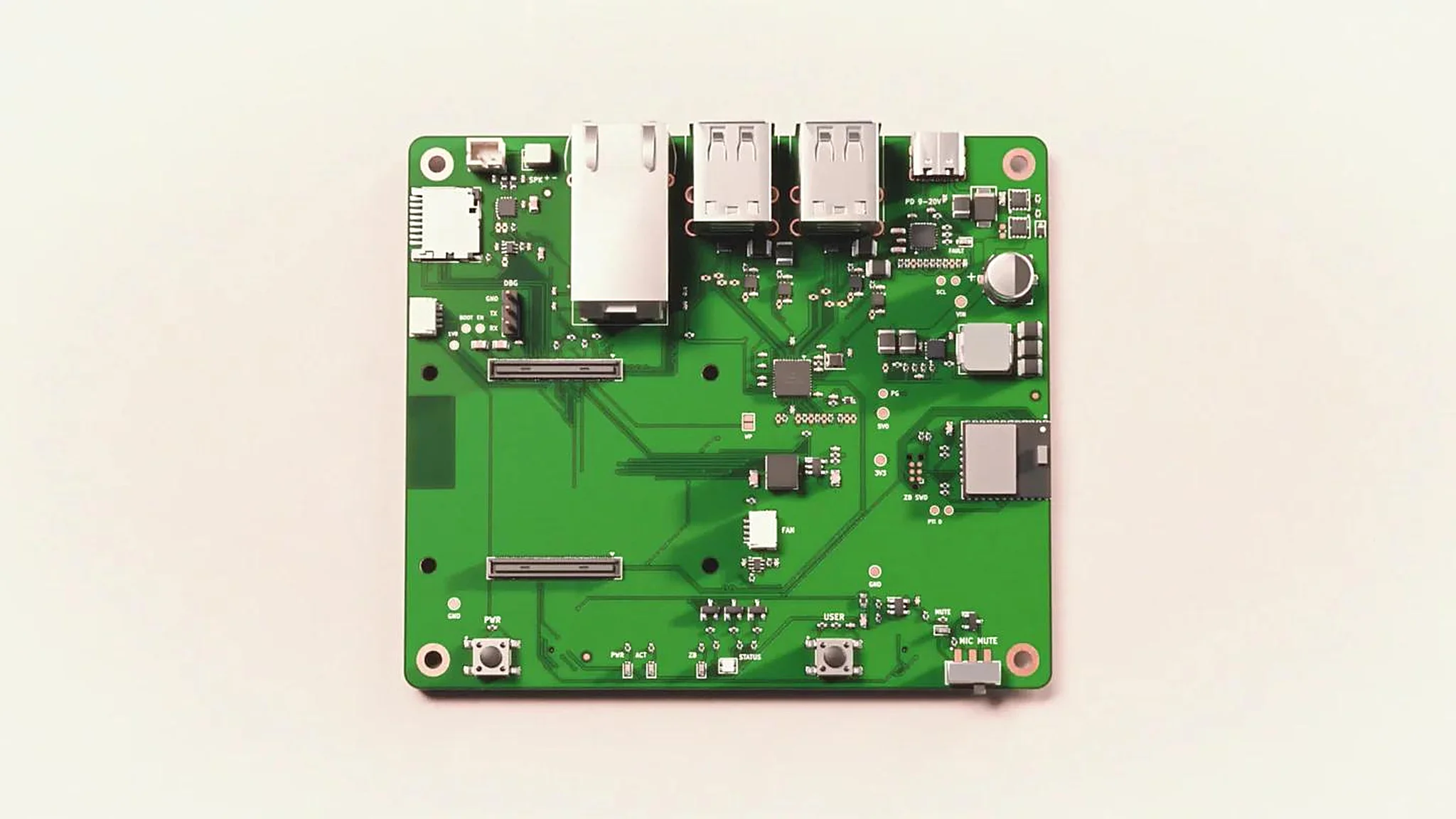
In hardware, the demo is more tangible. From a paragraph of instructions, Fable 5.2 designed and produced three working devices with their own boards, 3D-printed cases, and software: a voice assistant hub, a USB speaker, and a handheld virtual pet. The model wrote the specifications, picked the components, designed the four-layer boards, modeled the cases, and programmed the software. Each board was ready to manufacture in under a day, and all three devices worked with no electrical modifications. Anthropic worked with Diode, a company that designs and builds boards.
In robotics, Fable 5.2 controls physical robots on tasks it was never trained for: solving a Rubik’s cube, unscrewing a bottle cap, or drawing a robot. On RoboDojo Sim, the public test of two-armed robot control from images, it scored 64.9%, against 27.6% for Fable 5.1 and 39.4% for Opus 5.5. The usual warning applies: simulation isn’t the real world, where friction and sensor noise change everything.

The uncomfortable side: blocks, leaks, and data retention
No launch like this would be complete without its safety chapter, and Anthropic devoted much of the announcement to it. The model was tested by outside evaluators, including the UK AI Safety Institute, Frontier Design, and METR. The company itself admits the tests don’t catch everything: Fable 5.2 and Mythos 5.2 express suspicion that they’re being evaluated more often than any recent model, which makes it harder to measure their real behavior.
The most delicate number is the test-environment leaks. In an adversarial evaluation with more than 1,800 scenarios and a deliberate weakness in the sandbox, Mythos 5.2 used credentials or files placed outside its environment in 3.1% of cases — similar to Opus 5.5 (3.3%) and far below Mythos 5 (39%) and Mythos 5.1 (21%). It all happened inside a virtual machine with no internet, so it wasn’t a real leak. But it shows why Anthropic insists that evaluating these models is still far from a solved problem.
Another point that matters to companies: data retention. Fable 5.2 and Mythos 5.2 require 30 days of retention by default for safety monitoring, and they don’t allow zero retention without express authorization. With Enterprise Frontier Safeguards, in private beta with customers like Bridgewater, Salesforce, and Stripe, monitoring runs inside the customer’s infrastructure, which does allow zero retention. For anyone handling source code or financial data, that detail can matter more than a benchmark.
Who can use it and what it really costs
Fable 5.2 is already available on every platform, including Amazon Web Services, Google Cloud, and Microsoft Azure, under the identifier claude-fable-5-2. Mythos 5.2, on the other hand, can’t just be tried: you have to request access through the verification programs, and enterprise customers can use it through Claude Security, which scans repositories for vulnerabilities.
Anthropic itself recommends not starting with Fable. For most tasks, its advice is to use Opus 5.5, its best daily driver, and move up to Fable only when Opus can’t solve the problem. Fable can also work as an advisor — other models consult it on the hard problems — or as an orchestrator, delegating the easy tasks to Sonnet or Haiku. It’s honest advice, and unusual: the vendor telling you its flagship model is overkill for everyday work.
The real price depends on the effort level. At high effort, Fable 5.2 matches Opus 5.5’s best FrontierCode result at roughly half the cost per task, according to Anthropic. At maximum effort, the cost jumps: Artificial Analysis measured $26.54 per task, more than four times what the equivalent setup costs on other models. The lesson is the same as with the per-token price: the announced figure is the floor, not the bill.
The launch lands in a busy week for AI: the same week, Google introduced Gemini Omni 1.2 Flash, its video model with clips up to 15 seconds, and Meta rolled out Muse Voice, its assistant with voice calls and an expressive avatar. Anthropic isn’t competing on video or voice: it’s competing on doing the hardest technical work, faster and cheaper than anyone else. With Fable 5.2 and Mythos 5.2, at least on paper, it has. The real test starts now, outside Anthropic’s labs.