
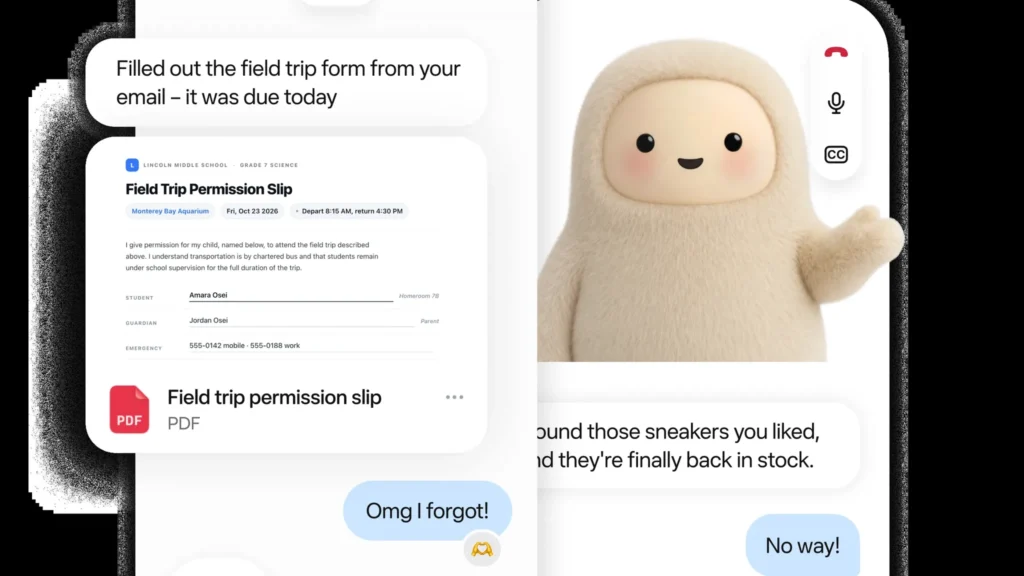
Meta has taken the step it had been teasing for months: its AI assistant, Muse, no longer just answers in writing. With “Give Your Muse a Voice,” announced on November 5 on Meta’s official blog, Muse adds real-time voice calls and video calls with an expressive avatar that reacts to what it hears. The rollout has already started in the Muse app — on mobile, on the web and on Mac — in the United States, the first market.
It is not a small change. Until now, talking to an AI assistant meant, in practice, typing to it. Meta wants the conversation to be just that, a conversation: speaking out loud, interrupting, changing the subject and watching the avatar respond with gestures and expressions. The feature had been previewed at Meta Connect 2026, on September 23, and now it is reaching users. The difference is in the feel of it: instead of sending a command and waiting for an answer, you are in the middle of an exchange, and the avatar’s reactions make it clear it is listening, not just processing.
Meta’s bet is that voice becomes the normal way to use its assistant. Writing a prompt forces you to think about how to ask for things; talking lets you think out loud, hesitate, correct yourself and let the conversation build itself. That is why the announcement insists you can talk to Muse the way you talk to a real person: no script, no formulas, no waiting for it to finish before you jump in.
What Muse Voice is and how to start
Muse Voice starts from the chat itself: just tap the phone icon in the top-right corner. From there, the conversation is by voice, in real time, and you can see the avatar in three views: voice only, the avatar next to the chat, or full screen, face to face. Each view fits a different moment: voice only when you are on the move, the avatar beside the chat when you want to keep an eye on what Muse is writing, and full screen when the conversation itself is the whole point.
Behind it is a combination of two technologies Meta introduced together: Muse Realtime Voice and Muse Realtime Avatar, a single streaming system that syncs the voice, the lip movement and the avatar’s expression. In practice, that means the character does not just talk — it moves and reacts while it talks, with instant responses and the chance to interrupt it at any moment, the way you would with a person.
Another difference from written chat is that Muse can keep working in the background while you talk. Meta’s idea is for the conversation to go along with whatever you are already doing: thinking through ideas while you walk, planning a trip while you cook, or rehearsing a presentation without having to sit down and type out every instruction.
An avatar that reacts to how you talk
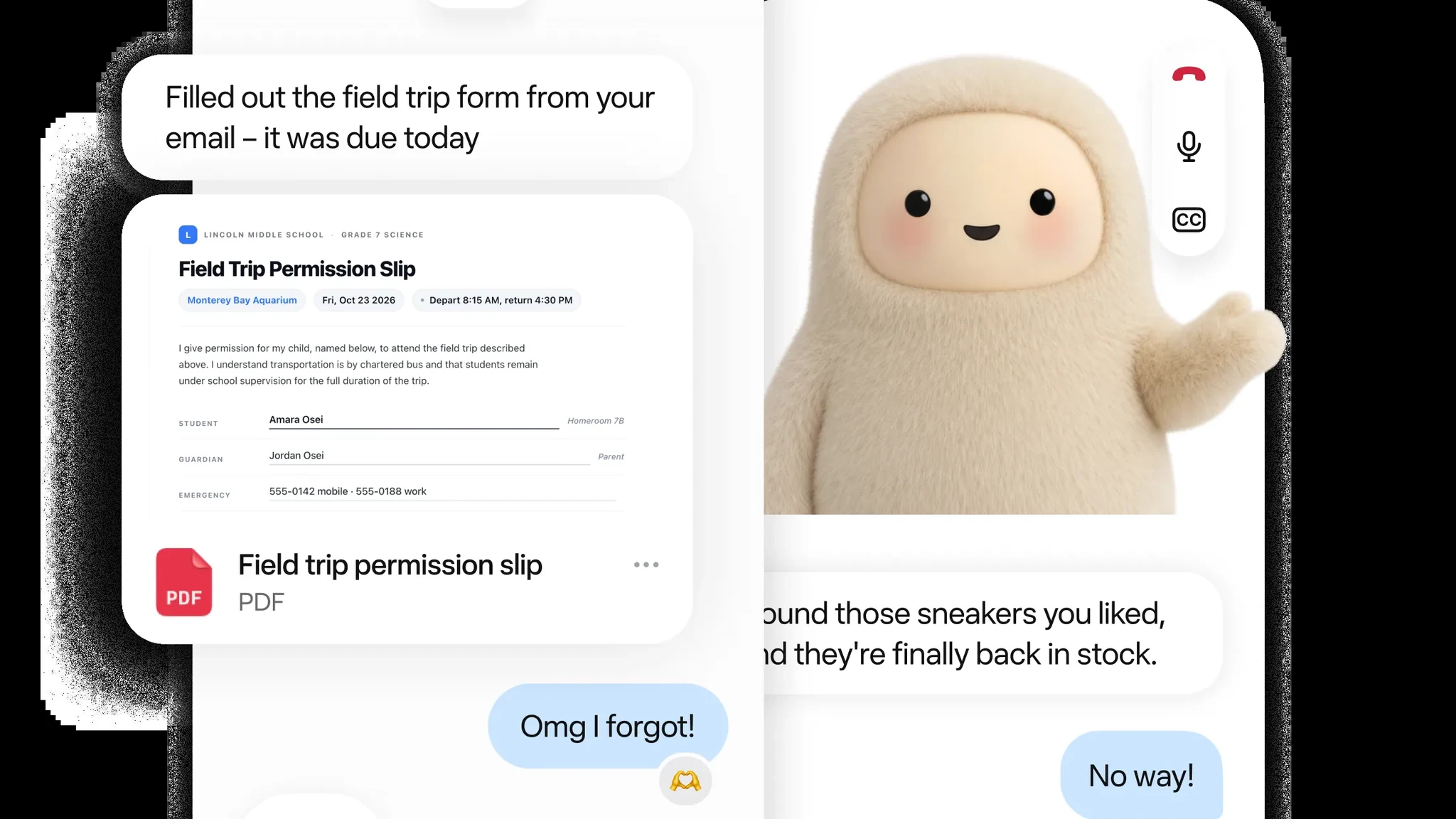
The default avatar is Jolly, a cream-colored furry character who has become the public face of Muse, but it is not the only option: the avatar can be customized into a person, an animal or another character. The same goes for the voice: there are hundreds of voices to choose from, and you can describe the style you want — Meta gives “the energy of a New Yorker or the style of a pirate” as examples — and change it whenever you like. That freedom matters more than it sounds: the voice you want for brainstorming is not necessarily the one you want for a calm evening chat, and Meta is letting the user decide both.
The avatar uses subtle expressions and gestures that match the tone of the conversation. If the user is excited, the avatar shows it; if the conversation turns serious, so does it. In a way, it is what Meta has been chasing for a long time: an AI that does not just understand the words, but responds to the way they are said.
There is one important nuance: the video is one-way. Muse hears the user, but it does not see them. What looks like a video call is really the character reacting to your voice in real time. And a warning from Meta itself: the examples shown in the ads and demos do not necessarily reflect the avatars available in the app. Muse, on top of that, is for users aged 18 and over.
What voice is for instead of typing
Meta puts three uses front and center: thinking through ideas out loud without drafting the exact prompt, planning trips, and rehearsing job interviews, presentations or pitches. These are tasks where talking is faster than typing, and where the conversation takes shape as it goes, with interruptions and on-the-fly corrections.
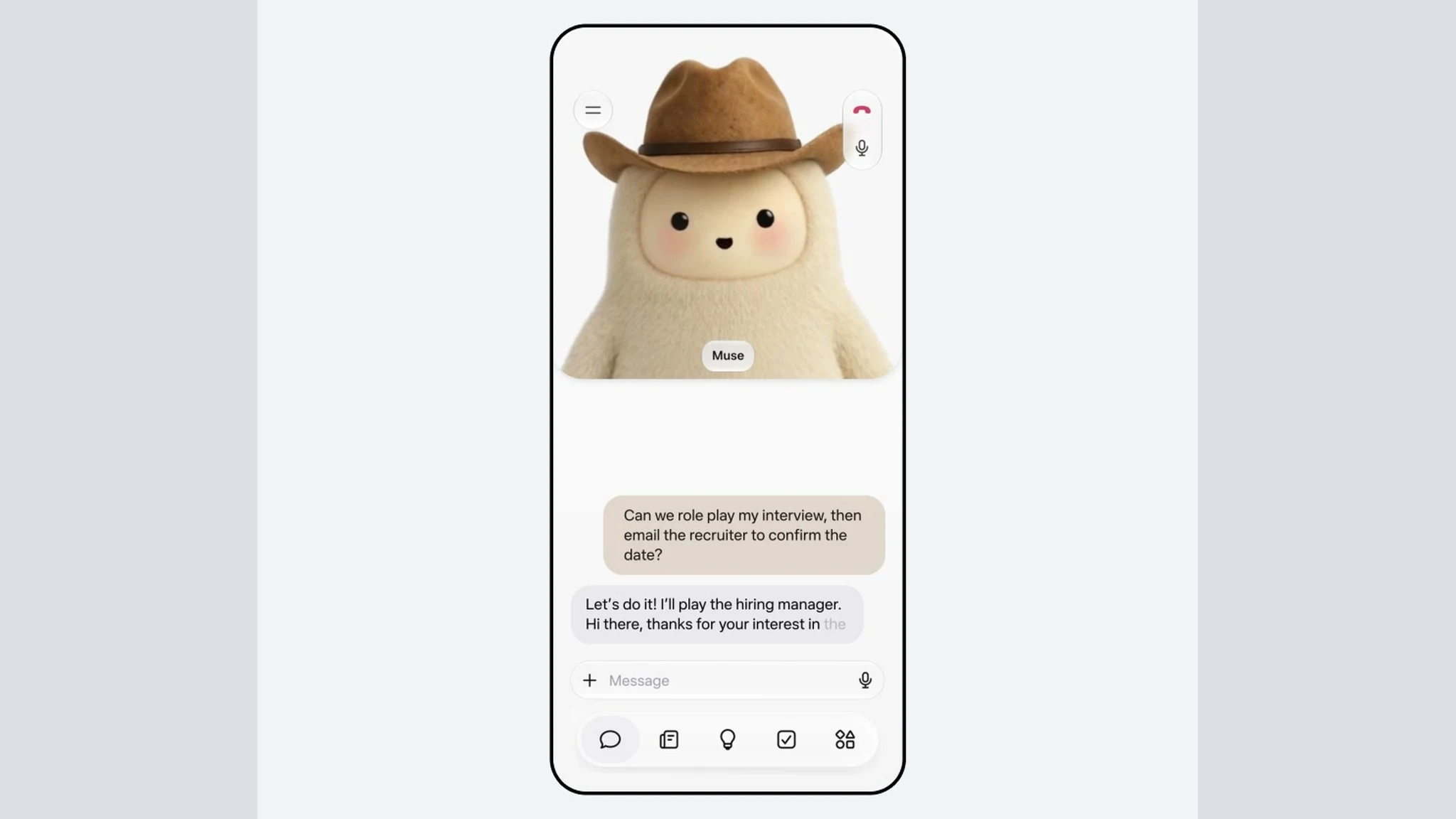
The official demo shows it with a concrete example: a user asks Muse to rehearse a job interview with him and then write an email to the recruiter to confirm the date. Muse takes on the interviewer’s role and the conversation goes from there. It is the kind of back-and-forth that gets slow in text and flows like a normal chat by voice.
That, in the end, is Meta’s argument: that talking to Muse feels like talking to a person. Not because the avatar is indistinguishable from one, but because the conversation has none of the keyboard’s friction: you talk, you interrupt, you correct yourself and you carry on.
It is also a change of habit. Many people think better talking than writing, and there are tasks — preparing a meeting, sorting out ideas for a project, deciding on a trip — that come out sooner spoken aloud than in a document. Voice does not replace text, but for those kinds of uses it has a clear advantage: you do not have to stop and write to get started. The barrier is lower, and that is the point: the best time to capture an idea is usually the moment it appears, not the moment you finally sit down to type it.
Mexico, Latin America’s first market
That same November 5, Meta also announced the arrival of the Muse app in Mexico, the assistant’s fifth market and the first in Latin America. The app arrives in Spanish, for users 18 and over, on iOS, Android, muse.ai and WhatsApp, with local connectors such as Cinépolis, Coppel, Despegar, Kavak, Kueski, Liverpool and Rappi, which will switch on gradually.
The announcement was made by Alexandr Wang, Meta’s chief AI officer, and the official Muse account on X. Don’t mix up the two announcements: what’s coming to Mexico is the Muse app; voice calls with an avatar, for now, are rolling out in the United States, and Meta has not named other countries or dates for Voice.
The app’s expansion is moving fast: the United States got it on September 8, Canada on September 18, Japan on October 23 and Singapore on October 27. Mexico is the next step, and the first in Spanish.
The local connectors are not a minor detail: they are what turns Muse into a useful everyday agent in Mexico, not just a chat. Cinépolis for the movies, Coppel and Liverpool for shopping, Despegar for travel, Kavak for cars, Kueski for credit and Rappi for home delivery. They’re switching on gradually, so not all of them will be available from day one, but the direction is clear: Muse should be able to get things done in the apps people already use. It is the same playbook Meta is running everywhere else, only this time with the services Mexicans actually open every day.
What’s next: glasses and Muse Charm
Meta has already said where Voice is headed: voice conversations will also come to AI glasses and to Muse Charm, the device the company is preparing. There is no date for either; the announcement only says they are coming soon.
The feature had been introduced at Meta Connect 2026, on September 23, along with the rest of the Muse news: its arrival on AI glasses in the coming months, using the computer in Muse for Mac, and new connectors with stores and services. Voice is the first of those pieces to reach users.
If voice comes to the glasses, the change is obvious: talking to the assistant without taking out your phone, hands free, while doing something else. And Muse Charm points in the same direction, a device designed so the assistant is present without going through a screen. Meta has given no dates, so for now these are promises, but they show where the company is headed: less keyboard, more conversation. The pattern is consistent across all of it — the assistant stops living inside a text box and starts living in the moment, wherever you happen to be.
The price, what Meta didn’t say
There is one question the announcement does not answer: how much it costs. Meta announced the rollout without mentioning a price or a required plan, and there is no official figure on whether Voice will be free or part of a subscription. Prices are floating around on social media, but they do not come from any Meta source, so for now there is nothing to take for granted.
It is a number worth watching closely, because Meta has been turning Muse into an agent that plans, books and buys through the connected apps. If Voice ends up being the front door to that agent, the price will matter as much as the technology. A free voice layer would put Muse in front of millions of people overnight; a paid one would make it a premium feature, and the choice will say a lot about how Meta plans to make money from an assistant that does more and more on its own.
What not to confuse it with
Voice is not the same as Muse’s phone-calling feature, where the assistant calls a business on the user’s behalf. They are two different things: one is talking to Muse; the other is Muse talking to others for you.
Don’t assume Voice is already everywhere. The rollout started in the United States, in the Muse app for mobile, web and Mac, and Meta has not announced dates for other countries. Anyone outside the US will have to wait, and in Mexico, for now, it is the app, not the calls with an avatar.
The announcement lands in a busy week for technology: while Meta gives its assistant a voice, AI, gaming and hardware are all moving at once, and Muse Voice is Meta’s bet that its assistant does not fall behind.
Muse Voice is not the first time an assistant has talked, but it is the first time Meta has put its avatar at the center of the conversation. If the rollout delivers on its promise — real-time voice, an avatar that reacts, and the freedom to interrupt — talking to an AI could stop feeling like using a tool and start feeling like having a conversation. It remains to be seen how long it takes to reach outside the United States, and what it will cost. For now, in the US, the voice is already on.