Google has now launched three Gemini 4 models in six weeks. Argon arrived September 30, Carbon followed on October 28, and on Wednesday, November 12, the third one showed up: Gemini 4 Hydrogen. If the name sounds familiar, that’s the problem — and the first thing to clear up. Hydrogen is not Carbon. Carbon, which we covered here on November 12, is Google’s strongest model, built for the hardest work and locked behind paid tiers. Hydrogen is the fast one, built for everyday coding and agentic workflows, and it comes with something neither of its siblings has: a free tier on the Gemini API.
The pitch fits the name. Hydrogen is the lightest element and the most common in the universe, and Google is selling this model the same way: light, fast, everywhere. It replaces Gemini 3.8 Flash, it runs in the Gemini app, in Search, in AI Studio, in the API, and in Antigravity, and per Google it finishes tasks 2.5 times faster than the Flash model it replaces. The question, as with every model launch, is how much of that holds up outside Google’s own charts — and this time, Google published a table that lets you check.
First, the confusion to clear up: this is not Carbon
It helps to place the three models side by side, because Google’s element names don’t explain themselves. Argon, from September 30, is the frontier reasoning model for most engineering and knowledge work. Carbon, from October 28, is the strongest of the three, built for long coding jobs, cybersecurity, and science — and it’s only available on the API’s paid tier and to Google AI Ultra subscribers, at $2 per million input tokens and $10 per million output tokens through November 30, doubling on December 1.
Hydrogen is the third leg: the everyday model. Google describes it as built for rapid execution across diverse agentic workflows — the model that writes the code, runs the tests, and verifies the changes while the frontier models handle the deep architectural thinking. It can stand on its own for daily work, or pair with Carbon and Argon as the high-efficiency execution engine in multi-model workflows. If Carbon is the model you call in for the hardest problem of the week, Hydrogen is the one you leave running all day.
The price — and the free tier Carbon doesn’t have
The pricing is refreshingly simple, which is not something you usually say about AI pricing. Hydrogen costs $1.50 per million input tokens and $7.50 per million output tokens, flat across its entire 1-million-token context window. No launch window, no doubling date attached — unlike Carbon, whose price doubles on December 1. Cached input runs $0.075 per million tokens on the paid tier. Batch API work is half price at $0.75 and $3.75, and the Priority tier runs $2.70 and $13.50.
But the number that matters most is the one in the free column. On Google’s own pricing page, Hydrogen’s input, output, and context caching are all listed as free of charge on the API’s free tier — the first Gemini 4 model to offer one. Argon and Carbon both say “not available” in that same column. The trade-off is in the fine print: on the free tier, your content may be used to improve Google’s products, while the paid tier keeps it private. Grounding with Google Search and Maps, meanwhile, isn’t available on the free tier at all.
For consumers, the price is simpler still: Hydrogen is rolling out in the Gemini app and in Google Search for everyone, and to paid Pro and Ultra subscribers in Antigravity. No subscription is needed to meet it.
Four thinking levels, and what the numbers say
Hydrogen is the first Gemini model to ship with four thinking levels instead of three: low, medium, high — the default — and a new xhigh tier. The idea is the same one Google has used all year: you pick how hard the model thinks, trading quality against latency and cost, so you only wait and pay for the reasoning depth a task actually needs.
On the Artificial Analysis Intelligence Index, Hydrogen scores 51 at its default high level, against 50 for Argon — the frontier model it sits below — and 54 at the new xhigh setting. That’s a narrow lead over Argon at default and a wider one at full effort, but the honest read is that Hydrogen isn’t trying to beat Argon at Argon’s game. It’s trying to be nearly as smart while finishing faster and costing less, and the index is the one place Google puts that in a single number.
The benchmark table, read honestly
Google’s announcement includes a full evaluation table, and it’s worth reading the whole thing — including the rows Hydrogen loses. Across ten benchmarks against Claude Sonnet 5.5 and GPT-6.1 Terra, Hydrogen wins seven. The wins: SWE-sweep at 13.5% against 3.1% and 5.8%; Agents’ Last Exam v1.1 at 71.6% against 60.4% and 69.8%; AutomationBench-AA at 76.1% against 71.8% and 60.2%; Vending-Bench 2 at a $14,549 bank balance against $11,165 and $9,107; MKA at 53.4% against 52.0% and 43.8%; Chartography at 66.6% against 61.6% and 63.2%; and HLE-Diamond at 58.8% against 53.3% and 47.3%.
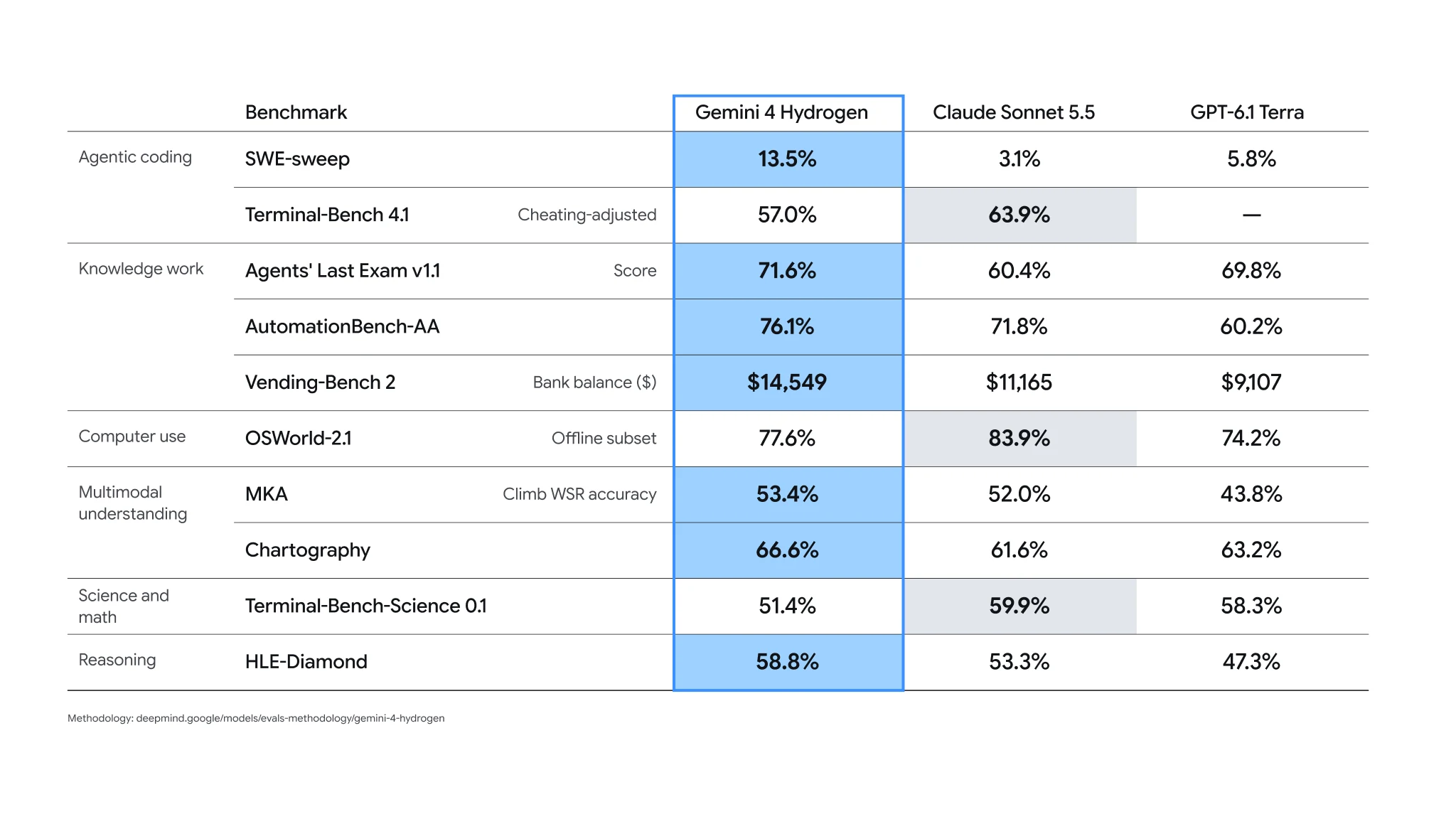
The three losses are all to Claude Sonnet 5.5, and the first one is the headline number: on Terminal-Bench 4.1, Sonnet scores 63.9% against Hydrogen’s 57.0%, with GPT-6.1 Terra not scored at all. Sonnet also wins OSWorld-2.1 at 83.9% against 77.6%, and Terminal-Bench-Science 0.1 at 59.9% against 51.4%. So the fair summary is a 7–3 win, not a sweep — and the benchmark Google’s own announcement leads with on speed, Terminal-Bench, is one of the three Hydrogen doesn’t win.
Two more numbers from the announcement deserve their labels. Against its predecessor, Hydrogen scores 57% on Terminal-Bench 4.1 versus 18.2% for Gemini 3.8 Flash — more than triple — and finishes tasks 2.5 times faster, per Google. Both are Google’s claims about its own tests, not independent results, and the table’s methodology note points to Google’s own evaluation pages. Beyond the table, Google reports Hydrogen ranking #1 on the Vals Tax Agent Bench at 52.3%, tying for #1 on Vals Legal Research at 55.8%, and ranking #5 on Agent Arena’s live benchmark.
What it’s actually built to do all day
The benchmark table is a snapshot; the job description is the point. Hydrogen replaces 3.8 Flash as Google’s everyday model, and its home turf is iterative repository coding and debugging — fixing issues, debugging, and answering codebase questions with focused, surgical edits, without rewriting unrelated files. In early testing with partners, Google says Hydrogen ran 2 times to 2.8 times faster than 3.8 Flash on complex graphs, SQL, and data-heavy enterprise work, while using 12% to 23% fewer tokens. It also cuts fabricated claims by more than five times compared with its predecessor, which is the kind of improvement that matters more in daily use than any single benchmark row.
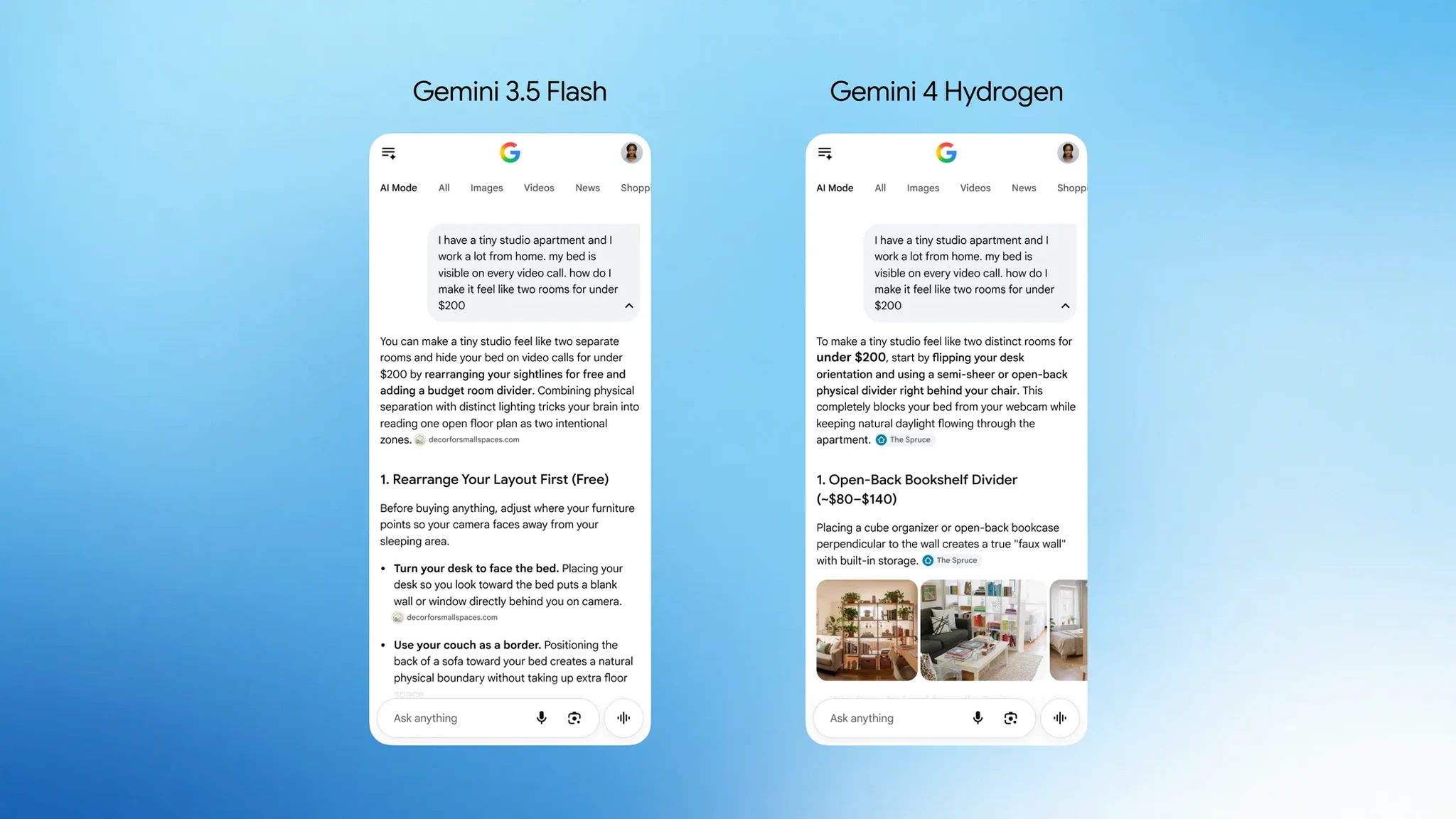
For regular users, the change shows up in the Gemini app and in Search. In the app, Google says Hydrogen follows instructions more closely across multi-turn conversations, calls the right tools more often, and gets to a reliable output with less back-and-forth — including pulling context from Gmail, Drive, and connected apps. In Search, it powers more helpful responses with a better read on intent, more visual and scannable answers, and a wider fan-out to relevant links. The demo Google chose is a telling one: Hydrogen turning real-time global lightning-strike data into an interactive 3D globe.
Orchestrator: Hydrogen as Carbon’s running mate
The most interesting part of the announcement isn’t Hydrogen alone — it’s Hydrogen paired with Carbon. Google is introducing Orchestrator in Antigravity, which switches between models inside the same session instead of running one model start to finish. Carbon takes the roles that demand the deepest reasoning — architectural design, coordination, auditing — while Hydrogen handles execution, and the two can run side by side: Carbon as coordinator, Hydrogen powering worker and verifier agents in isolated workspaces.
On Terminal-Bench 4.0, Google says Orchestrator reached near-Carbon task success rates while consuming 24% less quota and finishing 19% faster. That’s Google’s number, from its own test, but the shape of the idea is what matters: the expensive model thinks, the cheap model does, and the bill lands somewhere in between. Orchestrator is available to paid Google AI Pro and Ultra subscribers in Antigravity.
The safety claims, with the fine print
Google spent a good part of the announcement on safety, which makes sense for a model built to run agents on your behalf. The claims: Hydrogen reduces overreach in agentic tasks by up to 81% and under-service by up to 79% compared with 3.8 Flash, cuts misaligned actions and task shortcutting across tool-use and coding evaluations by 12 times, and is up to 2x less likely to bypass permission boundaries when a task is impossible or blocked. On indirect prompt injection, it’s more than 2.3 times as resilient as its predecessor on the Gray Swan benchmark, and it keeps 99.9% chain-of-thought legibility with zero deceptive reasoning edits across more than 200,000 audited turns.
The number to read most carefully is the honesty rate: 94% on Google’s own internal agent honesty evaluation. That’s Google grading its own homework, and it sits next to a false-refusal rate under 0.4% on HealthBench Pro — the model is much better at telling a real medical question from a biosecurity risk. None of this has independent verification yet, and for a model designed to take actions across your files and apps, the real test is what happens when it’s loose in the wild, not in Google’s lab. But the direction of the claims is consistent: this is a model built to be left alone with tasks, and Google knows that’s exactly where trust gets earned or lost.
Frequently asked questions
Is Gemini 4 Hydrogen free?
On the Gemini API’s free tier, yes — input, output, and context caching are free of charge, per Google’s pricing page, though content on the free tier may be used to improve Google’s products. In the Gemini app and Search it’s rolling out to everyone. Antigravity access needs a paid Pro or Ultra subscription.
Does Hydrogen replace Gemini 4 Carbon?
No. Carbon remains Google’s strongest model for the hardest work — long coding jobs, cybersecurity, science — and it has no free tier. Hydrogen is the fast everyday model, and the two are designed to work together through Orchestrator in Antigravity.
Is Hydrogen better than Claude Sonnet 5.5?
On Google’s own benchmark table it wins 7 of 10 tests against Sonnet 5.5 and GPT-6.1 Terra — but Sonnet wins the three it loses, including Terminal-Bench 4.1 at 63.9% against 57.0%. These are Google’s benchmarks, not independent results.
What are the four thinking levels?
Low, medium, high (the default), and a new xhigh tier. Higher levels trade more waiting time and tokens for better results; Hydrogen scores 51 on the Artificial Analysis Intelligence Index at high and 54 at xhigh.
Where can I use Gemini 4 Hydrogen?
In AI Studio and Android Studio, the Gemini API, Gemini for business, the Gemini app, Google Search, and Antigravity for paid Pro and Ultra subscribers — plus Gemini in Google Sheets for Pro and Ultra subscribers.
When did Gemini 4 Hydrogen launch?
November 12, 2026, with Google’s announcement post updated on November 13. It is the third Gemini 4 family member in six weeks, after Argon on September 30 and Carbon on October 28.